the 18-month hiring funnel: from campus to code review, why 92% of indian engineering grads get the wrong job
92% of indian engineering grads get the wrong job. the 18-month hiring funnel, from campus to code review, is broken; dreamclerk offers a fix with real work, not resumes.
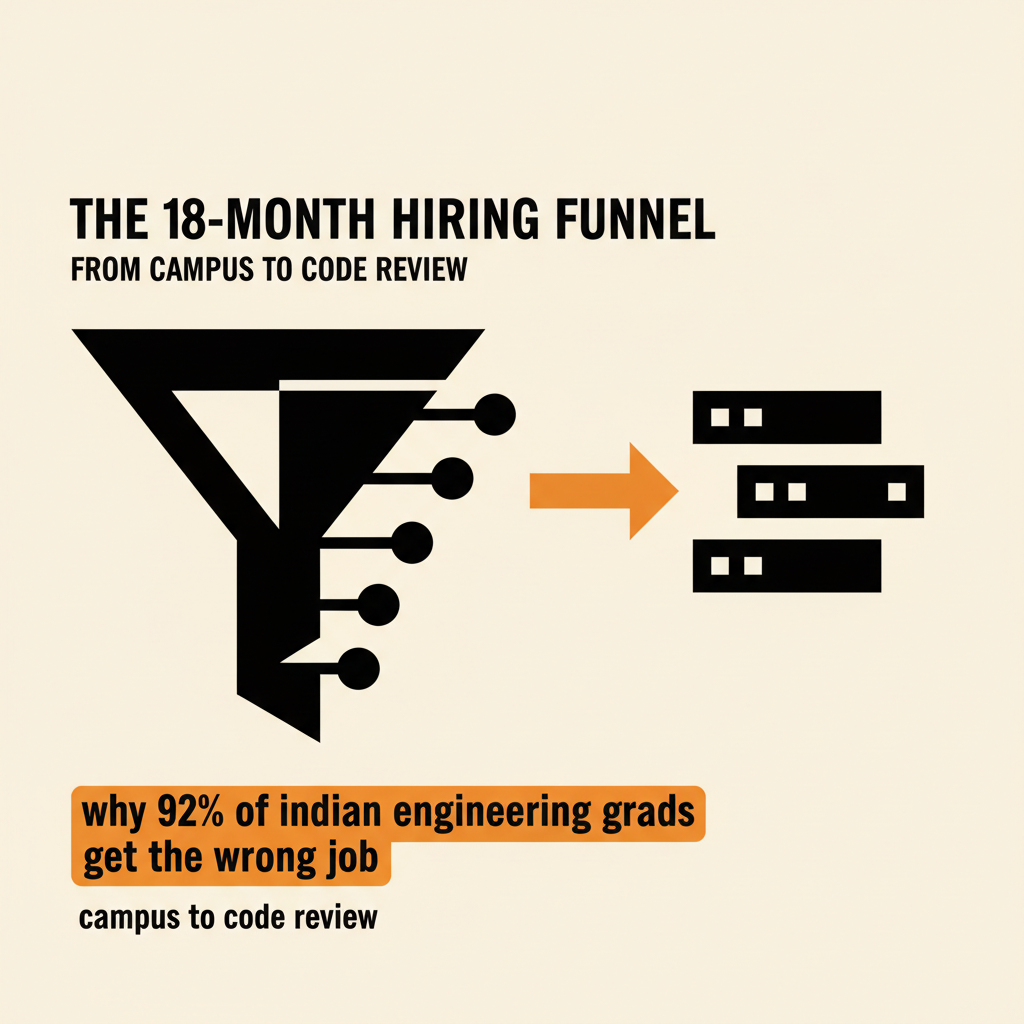
an 18-month problem. it starts subtle, pre-final year, maybe even earlier. you’re an engineering student. good grades, decent dsa skills from leetcode. you’re aiming for a product company, maybe even faang. but the system, the 18-month hiring funnel you're about to enter, is rigged. it's rigged not necessarily to fail you, but to misdirect you. to absorb you into a less-than-optimal role with a service company, despite your potential for a product-focused career. this isn’t about 8% unemployment; it’s about a 92% underemployment rate for engineering graduates from tier-2 and tier-3 colleges, pushed into roles that don't leverage their core capabilities, leading to low growth and high churn. this isn’t conjecture. it’s the standard pipeline for indian tech hiring.
the pre-final year prelude: campus placements and the mirage of opportunity
it begins with campus placement. for most indian engineering students, especially those outside the top iits, nits, and bits, this is the primary, often only, access point to the job market. companies descend, mostly service companies, alongside a handful of product outfits. the narrative is clear: get placed, secure your future.
the resume lottery and dsa gauntlet
your resume, often a template, gets optimized for keywords. cgpa, a project or two (mostly academic, rarely shipped), maybe a coding competition rank. then comes the dsa gauntlet. 90% of phone screens and initial interview rounds hinge on data structures and algorithms.
this process, while a proxy for problem-solving ability, is a poor predictor of real-world engineering aptitude. it measures abstract problem-solving under artificial constraints, not the collaborative, iterative process of building and shipping software. it optimizes for rote learning, not practical application. faang companies and top product outfits also use dsa, but often follow it with deeper system design, behavioral, and practical coding rounds. for service companies, dsa is often the primary filter.
the service company acquisition model
service companies have high volume hiring needs. they require bodies to staff client projects. their hiring funnel prioritizes absorption. they can hire hundreds, sometimes thousands, of freshers. the dsa round, coupled with basic aptitude tests, becomes an efficient, albeit blunt, instrument to filter a massive applicant pool. they are less concerned with specific tech stacks or demonstrable product experience, because their model is built on training and deploying. the promise: a stable job, decent starting salary. the reality: often a role far removed from core product development, sometimes involving maintenance, testing, or legacy system support. the 18-month cycle starts here.
the offer letter: a contract for misdirection
you get an offer. relief. celebration. for many, this is the culmination of four years. the first concrete step into a career.
except it’s often a contract for misdirection. the job description might be vague. the technology stack, if mentioned, might be broad. the specific team, project, or even the nature of work is often unknown until well after joining.
for 92% of graduates from tier-2/tier-3 colleges, this offer is from a service company. salaries might range from 3 lpa to 6 lpa. compared to the 12-25 lpa offered by top product companies, it’s a significant disparity. but more critical than the initial salary difference is the long-term career trajectory.
the first 6-9 months: skill atrophy and career inertia
you join. the first 6-9 months are critical. this is where the underemployment entrenches itself.
training programs vs. shipping products
most service companies have extensive training programs. several weeks, sometimes months, dedicated to learning new tech stacks, company processes, and soft skills. this sounds good on paper. in practice, it’s often generic, high-level, and disconnected from immediate project needs. the training environment is a simulated one, lacking the pressure and tangible outcomes of shipping real code.
contrast this with a product company, where a new hire is often onboarded directly onto a team, given specific tickets, and expected to contribute to a live product within weeks. the learning is hands-on, contextual, and driven by actual user needs.
in service companies, by the time you're assigned to a project, several months have passed. your dsa skills, rusty. your academic projects, distant memories. your ability to ship, untested. you are now trained in a specific, often narrow, technology and deployed as a resource.
the project treadmill and lack of ownership
projects cycle. you might work on one client project for a few months, then another. the focus is often on deliverables, meeting client specifications, rather than innovation or deep technical problem-solving. ownership of the product's vision or architecture is rare. you are an executor.
this environment, while providing employment, stunts genuine engineering growth. you become adept at following instructions, conforming to client requirements, and operating within established frameworks, but less adept at initiating, designing, or iterating on a product. the skills valued (client communication, project management, specific tool usage) often diverge from what differentiates a top-tier product engineer (system design, architectural thinking, independent problem-solving, code quality, shipping speed).
what the numbers say: the cost of misalignment
the systemic issues manifest in clear data. consider these figures, based on industry reports and an analyses of recruiting cycles:
- 92% of engineering graduates from tier-2/tier-3 colleges are hired by service companies in their first job.
- average fresher salary gap: 3-6 lpa for service company roles vs. 12-25 lpa for product company roles. this gap often widens over 3-5 years.
- attrition rates: 30-40% for freshers in service companies within the first 18-24 months. the primary reasons cited: lack of challenging work, misaligned skillsets, desire for product roles.
- time to first pr/shipped feature: often 6+ months for a service company fresher to contribute meaningfully to a client project, compared to 1-3 months at a product company.
- re-skilling cost: companies spend significant resources (estimated 50,000 - 1,00,000 inr per fresher) on training programs that often don't equip engineers for product-centric roles.
- hiring slowdown impact: in economic downturns, service companies often reduce fresher intake first, impacting the largest pool of graduates. product companies, while also cautious, tend to prioritize hiring 'ready-to-ship' engineers capable of immediate contribution.
- hiring funnel efficiency: a service company's fresher hiring funnel might process 10,000 applications for 500 roles, whereas a product company might process 2,000 applications for 50 roles, with a much deeper, more selective screening process beyond dsa.
these numbers don't just reflect individual choices; they highlight a deep, systemic inefficiency in india's engineering hiring funnel.
beyond service: the product engineer's path, and why it's blocked
the path to becoming a product engineer is distinct. it requires a different set of experiences and demonstrable skills.
the product engineering skillset
product engineers build. they own features. they understand user needs. they collaborate closely with product managers and designers. their skills include:
- system design: architecting scalable, robust systems.
- clean code & maintainability: writing code that others can read and extend.
- debugging & problem-solving: efficiently identifying and resolving complex issues in live systems.
- api design: creating intuitive and effective interfaces.
- version control mastery: git workflows, effective prs, code reviews.
- shipping mentality: bias towards action, iterating quickly, delivering value.
- critical thinking: evaluating trade-offs, making informed technical decisions.
these are rarely developed or prioritized in the typical service company fresher role. where do you get them? traditionally, through internships at product companies, open-source contributions, or personal projects that involve shipping. but these opportunities are scarce or not sufficiently recognized by the traditional hiring funnel.
resume theatre vs. demonstrable work
the current hiring process relies heavily on resume theatre. keywords, cgpa, alma mater. then it filters with dsa. it doesn’t ask: "show me what you've shipped." it doesn't verify your git history, your prs, your code review feedback.
this creates a perverse incentive. students focus on optimizing their resumes and dsa scores, rather than building and shipping. they spend hundreds of hours on leetcode, but zero hours on contributing to a real codebase outside of a highly structured, academic setting.
for product companies, this means they often struggle to find truly "ready-to-ship" freshers. they often end up hiring experienced engineers or investing heavily in their own internal academies, bypassing the general fresher pool from tier-2/tier-3 institutions, further entrenching the imbalance.
dreamclerk: an alternative funnel, built for shipping
this is where dreamclerk comes in. we understand the 18-month problem. we understand the 92%. we’re building an alternative.
instead of resume theatre and abstract dsa, we focus on actual work. real prs. real code review. a verifiable json cert of completed sprints. we are creating a parallel hiring funnel, one that prioritizes demonstrable shipping capability over keywords and dsa scores for roles that require application, not just theoretical recall.
how it works: the dreamclerk sprint
- 8-week sprints: you join a sprint track focused on a specific tech stack and product.
- real features: you work on real features, building out parts of an actual product.
- github-centric: all work is done in github. real prs, real issues, real commits.
- code review: experienced engineers review your code, providing detailed, actionable feedback. this is invaluable for learning to ship production-ready code.
- test-driven development: you learn to write tests, ensuring code quality and robustness.
- verifiable json cert: upon completion, you receive a cryptographically verifiable json certificate of your work. this isn't just a pdf; it points to your github contributions, your prs, your code reviews. it's your public, reviewable record of shipped work.
- direct connections: perform well, and you get direct connections and referrals to our partner companies looking for engineers who can actually ship. these are product companies.
we bypass the traditional funnel. we cut through the noise. hiring managers and tech leads at product companies can directly see your work, your collaboration skills, your ability to integrate feedback, and your shipping velocity. this replaces the abstract proxy of dsa. we level the playing field, giving tier-2/tier-3 grads direct access to opportunities previously exclusive to a select few.
a better signal for product companies
for product companies, dreamclerk offers a pre-vetted pool of engineers who have actually shipped. this significantly reduces their hiring risk and the time needed to ramp up new hires. imagine interviewing an engineer where you can directly inspect their code, their PRs, and their code review history before the first interview. this is dreamclerk. it makes the hiring funnel more efficient for companies and more equitable for candidates.
what you can do this week
don't wait for campus placement to define your trajectory. the 18-month clock is ticking.
- assess your core skills: beyond dsa, what have you built? can you open a pr? can you articulate the design choices in a system? be honest.
- start small, ship often: pick a small project. build something, anything. deploy it. share it. even if it's just a landing page or a small api.
- engage with open source: find a project. read their contributions guide. try to fix a bug or add a small feature. experience real codebases.
- read code reviews: look at large open-source projects. observe how experienced engineers give and receive code review. this is a critical skill.
- explore dreamclerk: check out the tracks. understand the 8-week sprint model. look at the project goals. consider applying [/#apply]. we're building a network of engineers who ship.
- talk to product engineers: seek out engineers working at product companies. ask them what they actually do day-to-day. what skills do they value most? how do they learn?
the goal is to proactively build a verifiable history of shipping. not just a resume. but a public, reviewable record of your actual engineering abilities.
the 18-month funnel, the one that steers 92% into underemployment, is a construct. you can choose to bypass it. by focusing on demonstrable work, on shipping real code, and on building a public record of your capabilities, you reshape your own career trajectory. dreamclerk is a tool for that journey. it's time to replace resume theatre with verifiable work. it’s time to move toward an indian tech ecosystem that truly leverages its engineering talent. learn more about how we do it [/how].
<!-- related-posts:auto:start -->
related reads
- the 8-semester mismatch: why 4 years of engineering curriculum produces zero production code and how 8 weeks of structured sprints fix the gap
- the tpc's perverse incentive: why your college's training-and-placement cell ranks witch visits above product startups, why 38% of tier-2 and tier-3 freshers never see a product recruiter on campus, and how a public shipped-sprint record skips the mass-recruiter funnel
- the 9.4 lakh rupee handshake: why 71% of indian freshers sign their first offer without a counter and how a public shipped-sprint record turns 'i'm worth more' from a wish into evidence
<!-- related-posts:auto:end -->